LSTM Chancellor’s Lecture: Elhadj As Sy
- Video
10 December 2025
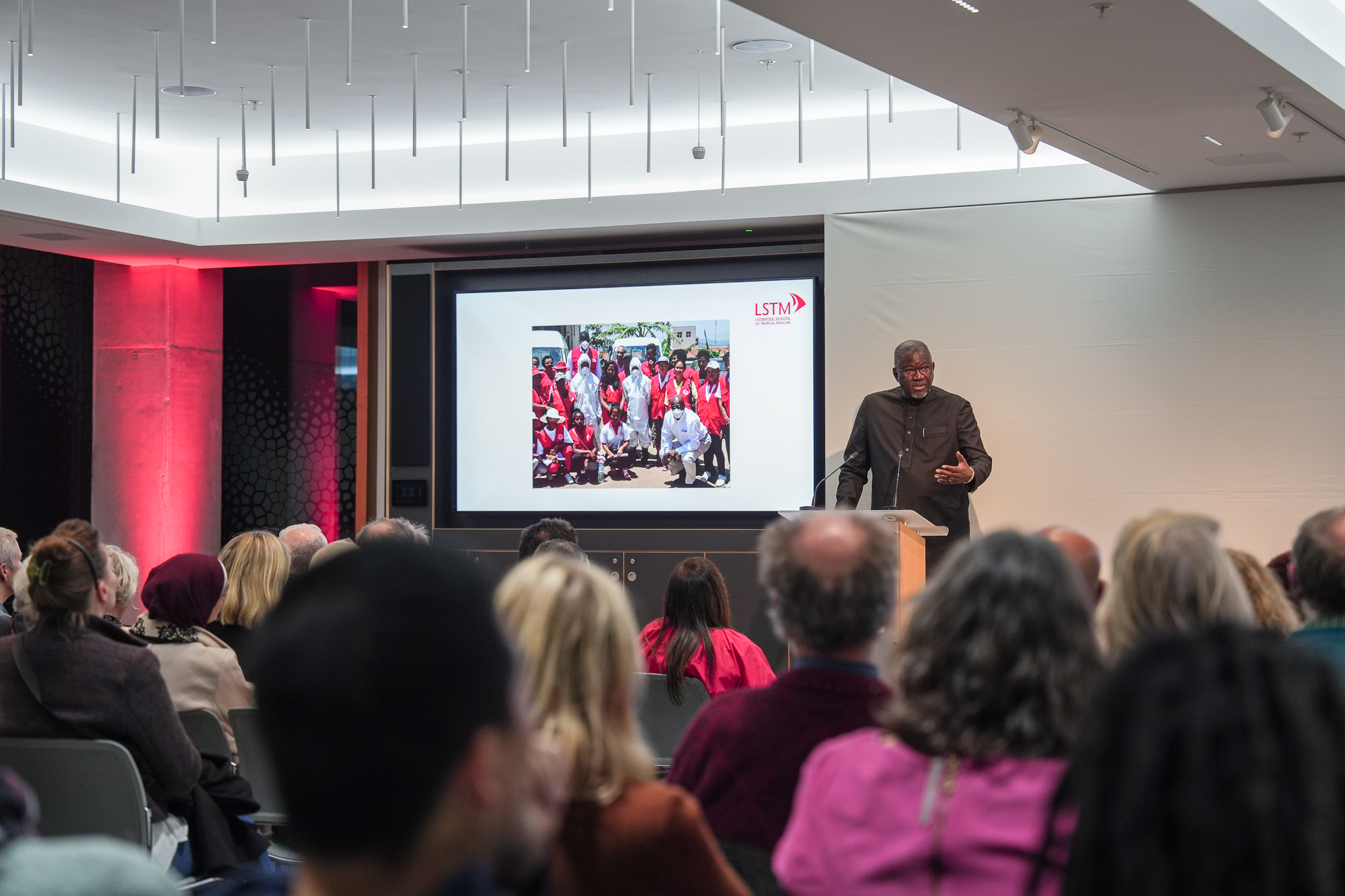
Working in humanitarian settings: health as a damage; health as a response
Elhadj As Sy was installed as LSTM’s first Chancellor in December 2024. An internationally acclaimed global health and humanitarian leader, he is Chair of the Kofi Annan Foundation Board and former Secretary General of the International Federation of Red Cross and Red Crescent Societies (IFRC).
Widely recognised for his down-to-earth, modest style and his personal commitment to the most disadvantaged communities, As used his first public lecture “Working in humanitarian settings: health as a damage; health as a response” to share powerful insights into the realities of humanitarian work and the role of health in global development.
So good evening everybody. Uh, I hate to interrupt the chat, but we’ll have plenty of time to do that later on. Um, and, and it’s a real pleasure as Ian’s vice chancellor to welcome you all here today for this very special and unique evening. I know that some of you have come from a long distance, uh, but there are many others online.
So, uh, wherever you are and wherever you come from, thank you very much for being here, and I hope you enjoy the evening. Uh, and before I hand over to our chancellor El Jai, I’d like to start with a few words about the important role that he plays here at LSDM. The Chancellor is a key role in the university acting as a ceremonial head.
And for us it’s a new role, uh, as is our first chancellor. Previous, we, previously we’ve had presidents, uh, and he’s following in the footsteps of those many individuals. But for us, it’s a really a key milestone as was appointed only last year in our hundred 25th anniversary year. We were looking for somebody that shared lst M’S value, that shared LST M’S Mission, and someone who had made a lifelong commitment to driving positive change and making an impact for those most in need.
Uh, and from a diverse shortlist of potential candidates, uh, we included people with a very strong global health activity, a strong global outlook. We were delighted to confirm. As, as our new chancellor, he’s undoubtedly recognized around the world as a humanitarian leader and he’s dedicated his career to driving change in the humanitarian sector.
He’s currently chair of the Kofi Noun found Nan Foundation Board and a number of, of multiple advisory groups, and I don’t quite understand how he keeps sane, given how much he travels around the world, uh, but those, those boards include welcome. He’s also had a vast experience in global health leadership in the humanitarian sector, uh, in many other sectors working on pretty much every continent.
It’s kind of difficult when you talk to as to find a country he’s not visited and doesn’t know intimately. Uh, and he’s worked in the International Federation of Red Cross and Red Crescent unicef, uh, United Nations program and hiv aids, the Global Fund, pretty much you name it, he’s been there. Uh, and that’s, that’s demonstrated in, in the contacts and, and the, and the wide network.
And I think also a number of great friends that have come here, uh, today to hear him speak. And we, we really appreciate that. And it’s kind of that lifelong commitment, his passion, his inspirational approach that made as the perfect choice for lsd, N’S first Chancellor. There’s no doubt, I think that over the last years, he’s more than just a master.
Last year, he’s more than justified that choice. He’s been a passionate ambassador for LSDM. He’s been given, given us very generously of his time. He’s led by example. He’s inspired the community around him and he’s impressed everyone with his wisdom and his compassion. And so I’m really delighted as to welcome you to share your experiences, uh, as and as as our first LSGM Chancellor.
Thank you.
Colleagues, uh, friends, these are humanitarian settings and I think the silence that we, uh, just experienced at the beginning, that is how it feels when you happen. You know, to stand, you know, in the middle of ruins, we once were nice buildings.
That is how it feels when you stand there, you know, thinking of those who live there before.
Some of them rescued, surviving, many buried forever. You know, under these rubles,
these situations are not normal.
These are not normal situations because, uh, overnight, once you know, proud fathers and mothers, you know, lose everything, including their own identity,
they have no names anymore. They’re called the refugees, the displaced people, the IDPs, the victims. These are no identities of anybody. These are just situations, situations where each of us could find ourselves in if we had the misfortune to have been in these places. You know, at that time,
this is not normal situation because again, once proud father, we used to care for his family, you know, has to line up 40 degrees, you know, under the sun to go back home with a bag of rice or a bag of maze, and it is not normal, you know, to look at this proud father and then you can read gratitude in his eyes, but the same time you can reach him.
Shame because of, you know, his dignity that he is being, you know, eroded.
That is not normal. ’cause when you stand here, like I did with Chris, I think it was in Palau, in Indonesia, where there was a phenomena called ion when suddenly the earth, you know, started melting. And then if you were not able to know to save anybody in the first hours, we just stand there and mourn and pray.
This is not normal. This is not normal that you express and then witness experience. This child who is so stands that he can’t even cry anymore. And this look will just, you know, prick, you know, into your heart. And then we’ll leave, you know, bruises on our own humanity. So we always have to remember and remind ourselves that when we work, you know, humanitarian settings, we are not working in normal situations.
So what are these people crying for? Of course, they cry for shelter and appreciate when they get it. They cry for water, sanitation, hygiene. What do they cry for really? Is you not to look at 122 million people today who have to leave home because home is no longer safe. If these people were a population of one country, it’ll be one of the biggest countries on earth today.
This is what we call the displaced, the forcely falsely, you know, displaced people,
people, they cry for normalcy, they cry for peace. They cry to recover a state of complete physical, mental and social wellbeing. A,
a complete state of physical, social, and mental wellbeing. That is how WHO define health in its constitution. So then it is fair to say that what people cry for above all is that they cry for. Health. They cry for health to be normal. Again, they cry for health to recover what is most important to them, to and to us, which is our own dignity.
So indeed, that’s what we do. If we work in humanitarian settings, we care, we support. We also try to accompany people to heal, to heal the trauma, the physical ones that we can always see. Also, also try to hail the invisible wounds that people live with to try to hail the relationship with oneself after having experienced this.
And maybe also to try to heal the relationship with each other so that we can be human again.
This is the reason why we say there is no humanitarian response without health. Otherwise, we’ve been in those many settings. We cannot remember any single one. You know, one Health, you know, is not a major, a major component of so much so that we often in advance, you know, prepare ourselves, you know, with what we called, you know, a toolbox because we experience sometimes that think we know it all.
Of course, we prepare for water, sanitation, and hygiene. We prepare for trauma. Of course, we prepare for psychosocial support in order a number of time. But every time we discover something that we’ve never been prepared for,
we never been, you know, preferred prepared to just, you know, meet the child. That just should be silly to your child. But then witness something that a true child should have never seen and experienced before. You never prepared that, you know, suddenly you become a, you know, frontline healthcare worker and having to deliver babies, you know, in the most difficult, you know, circumstances to see, again, the resilience, you know, of human beings.
Life lost, life gained, and again and again, and there is a reason why every humanitarian crisis become a children’s crisis. Either you are there or you watch it on tv, you see children everywhere or being impacted.
It is what health workers, you know, do in those difficult circumstances because they know, and we know that every mother, no matter where she’s just wants the best for her child, you know, either in the most affluent and rich societies or in a refugee camp,
because we know also that every baby. And every newcomer to our human, you know, society, you know, deserve the same care, the same love, you know, the same support
so that we see. Then while the situation that I was describing before, they do reveal quite often the worst in US human beings. We are the ones, you know, we fight each other. We are the ones we destroyed. What we have built, we’re the one, you know, who, you know, take us back, you know, to and destroy many of the progresses we have made, you know, in many of the areas that we work on on a daily basis.
But these situations are also, particularly if you have lc interventions, they do reveal the best in us. They show us how much we can care, how much we can support, how can, how much you know, we can hold on each other’s hands. And in those situations, you know, you see generosity in poverty in those situations.
You know, you see communities were there before us and that is important to remind ourselves, it doesn’t matter how quick, how fast we intervene. In any humanitarian settings, we’ll always find there are people who were there before us.
You may remember this, uh, reggae song, you know, of Burning Spear, talking about Christopher Colombo who said he is the first one who discovered America well. What about my grandfather who was there before him, but it is seriously than what we experienced. It is often the poorest of the poor who share the last grain they have, you know, with, you know, the newcomers in their communities.
It is often the poor woman with only one cross on her body that rip off, you know, to wrap, you know, the newborn baby, you know, before we arrive. It is also this poor lactating mother, you know, we forget sometimes in her own children and then jumped onto, you know, breastfeed. You know, this orphan baby or this baby with a mother who’s so sick, you know, not to take care, you know, of him or her.
That is very important to remember that. When we say that we need to have community engagement, then we ask ourselves who’s engaging home? And then we always remember that there are communities there reacting, responding, coping, caring, supporting. And if we do not understand that and then build on it, you know, our response, you know, will fall short.
And I’ll come back to that.
It is also amazing, you know, that again, in those very difficult circumstances, you know, the resilience, you know, and people can show, which is
something that you just, you know, never forget. Well, under the normal circumstances, we easily complain about your health issues. You are in the settings. You ask somebody as we do when we greet each other, how are you? Well after my leg, you know, was broken and I had, you know, some malaria, you know, afterwards.
And then, uh, unfortunately, you know, I got some chest infection. But apart from that, I’m fine. You know, I’m okay. Just, you know, show us again, you know, what resilience mean. Show us again what hope you know means, you know, and striving, you know, all of us to find, you know, solutions to the problems. You know, we face together,
but when we do so, we always have also to remember and remind ourself that we are human. We should always remind ourself that we are not the only creatures on this earth. If we, uh, work in humanitarian settings, we encounter also other creatures that also. Coping that also striving, that also trying also to run to safety.
And unless also we care, you know, about them in the one planet we share, we will never be able also to meaningfully care for each other.
Of course, we care for this creator, but when we do so, we care for her companion who would never at times, you know, leave her behind in the mud. And sometimes at the risk of her or his own life, human health, animal health, planetary health is maybe the one health, you know, that we should, you know, strive for.
And it finds, you know, its real meaning in the humanitarian settings, you know, where we were in those settings. You know, the other creators also run for safety like we humans do. And sometimes, you know, when we find ourselves in the same place of refuge, the encounter may not be so nice. They also run for safety during floods.
We also do, and this can be, you know, the consequences in order of these encounters. So when LSTM, you know, is working on snake back and ve it is something that is, you know, in normal settings, but it is more important in the settings, you know, that are not normal.
If you talk about also reaching those that are had reach and that are most vulnerable, where do we find them? So in those very places, and I think you know, beyond what we do every day in teaching, in research, but also in trying, you know, to implement, you know, those research, you know, to action, to save lives and alleviate human suffering.
This is one example I’m very proud of. You know, when I talk about what LSTM is doing, congratulations David for that.
But health is not only a response to emergencies and to humanitarian settings, health is also becoming an emergency of its own. And in a humanitarian setting of its own. The setting that I showed before, unfortunately are more frequent than ever before. They’re more severe than ever before. Conflict are protracted.
Some of them we are living in today. We don’t even remember when they started. We remember when the war in Afghanistan started. We still there. Who remembers when the war in Somalia started? We’re still there. Maybe we remember, but not exactly the number of years within which we’ve been in the wars in Syria.
Hopefully, you know it’ll be peace soon. The Protic nature, you know, of those crisis, you know, plus the severity of the shocks and hazards that are climate related, you know, that we are confronted with on a daily basis. You know, lead us to understand that shocks and hazards are natural. Disasters are human.
Our level of preparedness, our ability to respond early, to respond early, and when we respond, what are we leaving behind? So that next time around when we experience the same shock and assets communities and ourselves, you know, will be in a different capacity to withstand it. But year in Europe, out conflicting, conflict out, shock centers in shock centers out out.
We seem to be coming. You know, quite often, you know, like we are starting from the beginning, but the communities that we are serving, they were there before the shocks. They were there during and there thereafter. And we should not be surprised any time. You know, when we come and then we, uh, hear questions like, where were you before?
And why are you coming now with your Ebola? Why are you coming now with your Mabo? Why are you coming now with your lasa? Maybe because those are threats, you know, to you and then others. And only then we do care about us. And that is the reason why it is always important, you know, to understand those community dynamics.
You know, when we intervene, you know, in these settings, I.
Ebola response was not an example, you know, that show us, you know, how health, you know, is an emergency of its own, but at the same time, you know, does reveal the dysfunctionalities, you know, that we see in our systems that we need to understand better. We know, for example, that people deceased in North Ebola were up to 10 times more infectious, you know, than people who are living with it.
Amadou. And, uh, what was then very important, you know, to help people when they care for the deceased loved ones, they do not infect each other and continue to feel fuel. The epidemic
in the technical jargon, it used to be called dead body management. Communities don’t manage dead bodies. They respectfully. In a dignified manner, accompany their last, their loved one to their last place of rest.
Communities do not cover, you know, their deceased people in black body bags. How many of us, you know, did have in our stocks, thousands of body bags? You know, in case, you know, we are facing these emergencies. We never asked about the color. We never asked about how it should look like. We didn’t even ask, you know, how it should be called.
And of course, when we get into Sierra Leone and Liberia and Guinea, that was back in 2014, I think some of us was stoned. Our cars, you know, was toned. Some else workers were even killed, and we were called it community resistance. Community are resisting, you know, the response communities are resisting, you know, the vaccines.
But we didn’t simply do our homework, you know, so that we have communities buy-in and we buy in into communities dynamics, you know, so that we can accompany them, you know, to the real response that will be long lasting. When we moved, you know, from dead body management to safe and dignified burials, you know, to black body, black to white body bags, you know, then the dynamics, you know, become, you know, completely different.
So we always, you know, need to remember that. But I think what we need, you know, to remember also is that while our caring and support does not stop with the end of life. The way that then we treat people who are deceased is also an expression, you know, of health. It is an expression of false or common humanity.
Hence again, you know, the importance of the word dignified. You know, in what we are doing and everything, you know, we are doing, you know, in helps.
And that is the reason why, you know, if you look at the Geneva Convention on the convention on the AM admiration of the condition of the wounded and sick, um, forces, this was back in 1864,
I think that was from Sino, you know, in the battle, you know, of Sino, where people started, you know, to say that, well, even wars, you know, should have rules. In the way we treat, you know, people in the way we treat wounded soldiers, you know, in the way we also, we treat, you know, civilians and the conventions, you know, went on later, you know, to be improved.
Taking into account in the realities you of the situations that are coming from the field and the changes, you know, in behaviors and attitudes, even in the way, you know, war, you know, are conducted nowadays. There are not many soldiers who die on the battlefield because the battlefield is everywhere. The battlefield unfortunately, you know, is no longer those places where two armies, you know, meet and fight and then the winner go back.
You know, to the society. It is on our streets, you know, it is, you know, in our restaurants, it is in our schools. Unfortunately, it is even, you know, in our hospitals. You know, and our health infrastructure,
as I said. And then, uh, the, one of the rules, which I always remind myself, which is the Rule a hundred and 13th of the convention, which is about the treatment of the dead, the obligation to take all possible measures to prevent the death from being dis spoil or PH. So reminding us if we’re not able to care for our death, we’ll not be able to care for our living fellow human beings.
And that is all that continuation and then that cycle and back, you know, that make us human. And that is really what health, you know, is about in such a setting. But unfortunately, unfortunately today, health. It is not only a response else, also is a damage.
These were the blems that were protected, you know, before you don’t shoot at ambulances.
We do
in our professional life. Michel visiting you in the DRC to you. Remember, even in the course of own professional life, there were days, you know, where you go to the most difficult places for the most dangerous one. You put up the red cross flag and then the UN flag, and then you had a red carpet, you know, to go in the course of our own professional life.
We found ourself in the same situations, you know, where we had to hide the flags and that says, you know a lot about what it means, you know, to deliver health in humanitarian settings. What it means really to be aware of, you know, when we have to work in humanitarian settings,
it is so important, you know, to mention those health infrastructure, you know, where we have to build in the most difficult places. And sometimes when we describe the situation with a dom and gloom, which is a reflection of a reality that we all have to experience. And to be aware of. If we’re not aware of them, we’ll not be able to manage them.
They force us, you know, to be humble. They force us, you know, to question ourselves and question our own certainties. When we get into the field to question ourselves, you order to be open to new learning, you know, to new understanding and into new dynamics so that we can espouse them and then get the kind of results that we would like to see.
It is forcing us also, you know, to see, you know, next to the worst that I mentioned, you know, the best tools so that you experience and in the rewards that you get, you know, in being in such settings. And I used to say that in those settings, you see generosity in the middle of poverty, you see dignity in the face of multiple forms of humiliation.
You see resilience in the form of multiple deprivations. You will see also beauty, you see, even see beauty in misery because what every people you know would like to do in those settings is just, you know, to be human again, and then children, to be children again. When we were in Syria and in homes, you know, in the middle of the ruins and we meet children, they did not ask us for candies.
They did not ask us, you know, for health. They did not ask us for medication. They invite us, you know, to ride a bike, you know, with them, you know, between the ruins because they just want to be children again.
You know, they call on you and then tell you their soul stories, you know their stories. You know, that will be inspiring you and then stay with you, you know, forever. At times when you think, you think after having worked, like we present and introduce ourselves 35 years, you know, in the humanitarian settings, and then you think you know it all, and then you have the toolbox, you know, that will be solving all the problems.
And then you will be adding, you know, psychosocial support. And maybe now you need to bring in, you know, some anthropologists, you know, to better understand, you know, the community dynamics. And then you find yourself, you know, in the middle of a hurricane, you know, in uh, Barbuda and Antigua where everything is lost.
And then you open your toolbox. You have your water purification tablets, you know, you have your malaria tablets, you know, you have, you know what it needs, you know, to do first aid, you know, for your trauma. And then you realize that maybe you cannot access everything you know, that you wanted to buy. So you give cash, you know, for people to buy them themselves.
And then get the medication for the next course. And then this beautiful lady, you know, with the, uh, wonderful Caribbean accent that I cannot imitate and say, oh, thank you so much, sir, with this I can even buy a pair of earrings, you know, for my birth daughter’s birthday. Well, I didn’t think that, you know, we had, you know, put in a pair of earrings, you know, in our toolbox, you know, when we had to go, you know, in the humanitarian settings, you know, help people.
But at that moment, at that very moment, you know what the most important things, you know, to recover dignity, you know, for that lady and then get to the mental health status that she wanted it to be was exactly to get that. So we learned, and that is simply human.
You learn to be thanked, you know, with a small flower from a small child. And, um, I had hope, you know, this flower was in plastic so that you can keep it, you know, forever, but it will continue to grow in your own heart. And this is, you know, just, you know, to be human,
you learn to be asked, you know, to help, you know, to cycle well if you have fit, you know, like mine. So it’s difficult, but you try. And if I talk about, you know, beauty in the middle of all of that, you know, this is what it means. You know, that que you know, just, you know, a small person, small human beings, you know, out of rubs and then brought back, you know, this smile on the face, you know, that will be just telling you it is all worth it.
It is worth it because it is not always easy. And that’s important that each of us engaging in that. We remind ourselves we care. Also, we die while caring. We died 55 times in Syria during my time at the helm of IFRC 55 times life writing letters of condolences for people who come just, you know, a week before look at you and say, I’m so inspired by what you are doing.
I wanna go to the field and then make a contribution and never come back again. You know, that is also a reality, you know, that we have to face. We did it, you know, 12 times, you know, in Yemen that was in a period of one every month in a year, you know, 12 time and at least, you know, can go in and on and on.
The reason why, when I often talk about weak errors, we need to care about ourselves. And we need to care to build that community of carers, you know, to support each other, you know, continue to cope because you will never get used to that. It doesn’t matter how many times you do it, it doesn’t matter how long you do it, the day you think you’re used to it, and then you don’t feel the pain anymore.
That is maybe the day that you should stop, you know, doing it. But how to find the right balance, you know, to feel it, but at the same time, you know, have the force, you know, to continue. And nobody and none of us alone, you know, can do it well. I see if you see my friends here sitting and then coming all the way thousands of miles away to come and be here.
It’s not to listen to what I’m saying because they lived it many times. Like I did. Some of us, we lived it together in the field. It is a community of carers that I’m talking about. We cried on each other’s shoulders, Michelle, a number of times, you know, just because that what we’ve seen and how we needed to support each other, you know, to move on.
Amadou, we did it on the lap, in the lap and in the field together. Many of these pictures were taken by Chris himself because we were there experiencing, you know, the same thing and then go back, you know, either under our tent and then back to where we belong, to have to see how we can support each other to move on and then to carry on.
We also build that communities that almost, you know, become our own family. So, Doda walked in my office many years ago as a very young student saying, okay, I just wanna volunteer and then make my contribution. I volunteered and later on become the director of the very office, you know, that he worked on.
And then today one of the greatest leaders, you know, worldwide to knee, you keep on the flying burning to hand it to the next generation for excellence in research, you know, in Africa. And I can see no presentation needed in KU doctorate showing many other friends, Ray here, part of you know, many of the battles, you know, that we’ve been to.
Why I’m saying that, you know, this is the communities, you know, that really hold us together, that we get inspiration from. And sometimes when we are in doubt, and it is okay to be in doubt, to doubt sometimes, you know, to question our certainties, to doubt, you know, to show our weakness, you know, in a safe environment.
And then to get the support that is required, you know, so that together. You know, we build that communities of carers, you know, thanking each other, supporting each other, and really congratulating each other under the very difficult circumstances. You know, that is what keeps us going. Now, in times with like these friends and colleagues, it’s time to not to go back to basics, you know, back to the international humanitarian law that has be respected, you know, so that we don’t accept that humanitarian space to keep on being shrinking.
And meaning that, you know, a courage, you know, to work in a humanitarian setting will be measured by the number of people that will be dying on the line of duty. That is totally unacceptable. We have to go back, you know, to basic you not understand that there is no peace without health. That there is no health without peace.
And the very communities that we’re working with, what they’re crying for, what they’re striving, that is the same thing that we all are crying for, which is, you know, for human dignity. Dignity, which is in the face of the multiple humiliation, if you compare it, you know, to a blanket that is, will be the last blanket, you know, that should be ripped off.
We need to be covering ourselves in order to have the self-esteem to seek for health, but also the respect for other in order to care and then support them. And then to go back to where we all belong to and share the values, which is the one and only humanity we all share. And then if what in that LSDM, we say we serve those that are greatest in needs.
Those that are most vulnerable, those that are need us most. Here is a place, you know, to do it. And I hope that we will all support each other, hold each other’s hand, you know, so that we continue to save lives and alleviate human suffering. And I thank you,
uh, as thank you very much for that honest, that humbling, that, that thought inspiring talk. I think it will stay with many of us for, for a long time. We talked yesterday about the importance to our graduating students about the importance in standing on the shoulders of giants. And I think there’s no doubt we just heard a talk from one of those giants.
So thank you very much. If you’d like, have a seat.
And we’ve now got time for questions, um, as is happy to talk about questions on any topic I’m told. Uh, so feel free. He’s, how has a broad experience that we can share.
Microphone coming.
Hi, uh, good evening everybody. I’m, uh, Dr. Esra. I consider myself a genocide survivor. I came from Gaza, I’m a medical doctor, and now I’m a PhD HD student at Atium. So I’m a lucky person. Um, I have listened to every word that you said, and I have lived every moment. I have experienced everything that you described.
Describe, um. There are other things, you know that’s indescribable what, what I wanted to say that regarding the international laws and despite there are many international laws and despite the healthcare workers are respected and their work is appreciated in the field, especially in the humanitarian crisis or during a catastrophic situation like Gaza, despite all of this, none of international laws were able to protect healthcare providers in GA strip.
I’m saying that, and I’m so sorry, but I’m being too emotional because we lived and we lost all our beloved ones working in the field. And also one important thing that unfortunately Gaza Strip context as a humanitarian context is completely different than I say it. Because I saw that and I witnessed that from any different humanitarian context, not only in the aspect of the healthcare system, but also in different aspects related to the destruction of the whole infrastructure, the education collapse, malnutrition, the famine, et cetera.
So it was completely different and sometimes what applied in other contexts in other similar humanitarian contexts, like Syria for example, which is similar also in the cultural background and in certain aspects it’s completely different applying that in Gaza and vice versa. So. I just wanted to add these two important points because despite, we as a well educated persons were, were working in the field and we were considering ourself having impactful work there, but we were also experiencing what other people were experiencing.
And we were, as you mentioned, IDPs, so we lost part of identity. I’ve, unfortunately, in our home country, thank you very much and I hope the support, the interventions is continued there despite the genocide is being said, is it’s a stop, but unfortunately it’s still go ongoing, that suffering there. So I hope the support is still ongoing as before and even more.
Thank you.
Thank you. I would like to, uh. Thank you for, for that contribution. I happen to have been in Gaza a number of times. I’ve been there in times where it was more relatively calm, and I say relatively because, um, Gaza tripping itself is not normal. And then you have the big shock, you know, that happened, you know, after that is starting drawing attention to that.
And I’ve been there in different times, you know, different, you know, circumstances. What we humanitarian are doing. We are not the ones solving the root cause of the problems. We are alleviating, you know, the suffering. But at the same time, calling on those, you know, who then have, you know, the responsibility, you know, to solve the problems, you know, to solve.
My personal view is that the world is, there is a breakdown in leadership in the world to find solutions to the problems. That’s why I was talking about the protic nature, you know, of the crisis. Why do what start and then we cannot stop them. And that is becoming, and you know, unfortunately the rules.
And that is the reason why we are now talking about humanitarian settings rather than emergency settings. Because you know, the nature of emergency, it’s short. You go in, you solve it, you take it to a certain level of normalcy, and then you go to the next level of resilience and then people move on. But you start there, you are there, you know, almost, you know, or forever.
So I feel with you what you was talking about in God, and I could say. More about it at the political level, at the social level, at the dysfunctionalities of the world, at the breakdown of leadership, et cetera, et cetera, I think, and all of that, you know, is, is real. But none of that, you know, will, uh, prevent us, you know, for the sake of humanity to continue, you know, to do what we’re doing and never give up.
And that is the reason why, you know, you have the five fundamental principles when you work in humanitarian settings. They ask you not to be impartial. That does not mean you, you don’t care. They ask you to be neutral. It doesn’t mean that you don’t feel it, but these are, you know, principles, you know, that protect you.
But they ask you also to be independent and one forgets that. You talk about always, you know, neutrality. Impartiality, well. Be independent, you know, in with regard to all of that, you know, so that you shut, you can chart your own course in the response. But the mother of all those principles with the humanity, you know, the principle, you know, that we really have to, you know, focus on another by to no humanitarian settings is the same like the other, none of them.
And, um, you cannot even compare what is worth. You know, Robert, no, none of them is, you know, the same. If you see what is happening in Sudan today where people are trying to run for safety, where are they going to, to charge to northern church where there is nothing, the only hospital, you know, that they were, you know, having left, they then become bombed.
400 people killed in a hospital. Where people from South Sudan are running for refuge. 1 million of them were to Uganda.
Lebanon is hosting 1 million people. Jordan is hosting, you know, 1 million people. And then when you live in a very rich country, and then you have, you know, a hundred people coming. So it is an invasion, you know, of, uh, you know, of refugees. I think those are all the dysfunctionalities now that we are saying it is important, you know, to be aware of.
And that’s the reason why I’m insisting on that we are in a, you know, learning and training institutions where also our students, you know, are motivated coming in and doing, you know, humanitarian studies. They need to understand, you know, those settings, you know, not to be discouraged, you know, not to be, you know, overwhelmed, you know that you human feel it.
Fine. I can, as I say, you have. But then, you know, to be mindful of all of that in order to be able to navigate it and when it is then becoming overwhelming and too difficult to go to your, your communities, you know, and then get, you know, the kind of support that is needed to, you know, to carry on.
Thank you.
Any other questions? Anything online? Claire? No. Yeah.
Okay. Thank you for this opportunity. Uh, my question is, uh, I’m originally from Sudan, so as you know, the conflict is just ongoing in Sudan and before Sudan separate, even after separation. Also, uh, 2001. I was working with myself, the children in uk, in therefore, and this conflict started. I work in development sitting and emergency sitting in.
Therefore, and nowadays, every day the things is going worse. My question is, we as a humanitarian community and we have power of humanitarian aid, how can we use this power and convince or to force these two parties to sit for peace? My second question is, uh, our people now the they are, this generation is either peace or or refugee.
And I think this. This long time is affect their resilience, how we are as humanitarian workers or humanitarian community, how, how we can help them to things. The, the local people or people in the IP IDPs come to stand for themself and mobilize themselves again and stand for those people who kill them every time with different themes.
They started with pol, uh, politic things, and now they tend to be community or society. And they, every time those people who kill those people, they took different scene to kill more people. Thank you.
Thank you very much. The tragedy of, uh, Sudan, which, uh, also unfortunately also happened to now because being there in many times, you know, in different times it’s an eye witness also firsthand many of those events you, you know, that, uh, you were highlighting, we were there, you know, during the separation, uh, fact, I was sitting on the whatever called the official platform and, you know, celebrating the independence of South Sudan and then the tragedy of both countries, South Sudan and then Sudan always, you know, uh, on the shoulders of two people, and that is totally unacceptable.
Two people fighting for power and then burning a whole country. And creating this horrible situation, you know, that we were saying, which is just, you know, totally unacceptable. Then the world is watching, you know, and I keep on reminding often a time when I’m talking to leaders and political leaders on the African continent in particular, to say, stop the nonsense.
Care for yourself and for your people, because otherwise nobody will do it. Nobody cares if you believe, you know, frankly, that the world will stop and then concentrate on Sudan or Central African Republic, you know, or somewhere else in the saal. So we are just leading ourselves. So I think that leadership that should be emerging, you know, for peace and reconciliation can only come from within.
And often at the time it is just two people fighting for power, which is totally, you know, totally. You know, disgraceful, outrageous, and totally unacceptable that were the same in South Sudan. That is the same in Sudan today. And were the people suffering from it, you know, the most vulnerable, you know, those who don’t even have the right to exercise, you know, the citizenship on a basic, you know, level.
If you go now to those camps that you know very well because you’ve worked in UR then, then you ask how many people do even have birth certificate? How many children have birth certificate to show do their Sudanese? How many are old people have IDs, you know, to show, you know, their citizenship? Which is just the basic, you know, for the exercising your rights and getting your voice heard and getting, you know, visible, you know, rather citizens, you know, for that.
So the role I think, you know, for humanitarian, you know, workers is that there are many dimensions. Today I was focusing on health, which is very important. That is what people cry for. But the other one is protection. You know, protection in order of civilians. And those aspects that I talked about are part of integral, part of protection, birth certificate id, vital registration.
You know, having your right of citizenship, you are having your voice, you know, heard, you know, creating your own dynamic and environment, you know, to organize yourself your own way. Because we cannot get involved, you know, in the kind of a political dynamics, you know, to it. And then challenge, you know, leadership, you know, wherever we find it, in every corner, in every settings, be it in regional institutions, be it in the un, be it in many different paths where we intervene.
You know, to ask, you know, for solutions for it and keep on, you know, carrying, you know, forward in that regard. So I think it is high time, you know that local leadership for peace, regional leadership, you know, for peace, you know, be empowered and then support it, you know, to find lasting solutions, you know, for those problems.
Until then, unfortunately, we don’t have any other possibility and opportunities that to cover out the humanitarian space and again, alleviate human suffering, save lives in a way we can give hope, you know, when despair, you know, is the mo and then, you know, help to build on the resilience of people to carry on.
So I’m sure you could have your own views on the questions you have asked because you know the place very well, you know, being from it yourself. And I think that is maybe that common knowledge that we should gather all of us and, and play our beats. From wherever we are, you know, for, for lasting solutions.
Thank you. Time for one final question. Yeah. This one here at the front.
Thank you, sir. Such an inspiring, uh, inspiring lecture. I think it really cap captivated the audience. Um, and I, I agree with you pretty much every point you made, including the importance of this topic when the link between this and, and, uh, poverty is so ex is, so, is now so strong. I think even looking at your career, things have changed over the last 20, 30, 40 years, and now four, five out of 10, four tenths of the world, poor people are living in these situations, almost semi permanently fragile and conflict and violence affected states.
It’s not just an outlier, it’s now four 10th of the world population who are poor are living in these locations, which makes it doubly important. Um, but just want you take the big picture. The quick question I had for you over your career, you’ve seen these changes. Not all of them good, but there must be some good things as well.
Um, my question was, in your discipline, are there new techniques of resilience in health systems or new approaches you’re taking, which, um, maybe can never get us quite ready for the extreme pressures that you see, but at least can put us in a better position than we would be if we were just kind of going in the normal path.
Thank you.
Yeah, thank you very much. Uh, as first you are right, you know, if I had a map, a world map today, and I, uh, describe, you know, the places where there are conflict and I take another map, you know, where we have, you know, the shocks and hazards that are related, you know, to climate. And I take a third map, you know, where we have, you know, most recently the pandemics and epidemic outbreaks.
It’s highly likely, you know, that we find ourselves, you know, in the same places. So they’re interlinked, you know, for sure. And, uh, but as I said, despite all of that, you will have, you know, all those number of people still living in those settings, waking up every day, developing their own strategies for survival.
They open their own coping mechanisms and their networks of solidarity. And that is most of the time happening at the community level. That’s so I always, you know, put a great emphasis, you know, on that. And sometimes, you know the resolutions, you know, of the problems, you know, start also there. You order to go back all the way up.
I can give you a number of, uh, examples. You know, one. They experience, which was very moving for me, was Somalia, you know, where almost everybody gave up. You know, it’s a tribal uh, society, you know, there is nothing you can do about it, and so on and so forth. And then you have extremist groups, you know, that are very dangerous.
You know, they call them Islamist or you know, whatever. And, um, one of them was called Alshabaab and then they decided one day every organization leave UN N-U-M-S-F, red Cross, everybody you leave. Well, if Al Shaba ask you to live within 24 hours, well, you know, you think you better leave. So, uh, some of us, we decided, so let’s talk to them and understand why they’ll make this decision.
And, um, it was very complicated for security, of course. And then through different channels and negotiating rite of passage, talking to this tribal chief and then this religious leader and so on. So we arrived, uh, and meet to whoever was called himself, Sultan something. And uh, he said, okay, you are from unicef.
Say Yes, we was working. That was unicef. You said? Yes. Okay, you can stay. So when I was going there, so I had my notebook and I prepared myself very well. What will be, what I’m going to say to convince him, you know, children and then children in, uh, African societies, even children in Islam and stuff. But I didn’t say anything.
Say you can stay. Before I turned my back say, oh, you can stay because you never left us. That’s. Because, you know, the, my predecessors, you and the people who come after you in UNICEF and work there for 30 years and never left, gave me them the benefit, you know, of being accepted, you know, not to leave.
When I say communities don’t forget and they remember, that is a very important thing. That is one element only. The other element is that to talk to them, well there will be only local solutions to local problems, guys. You know, what can be done? They started, you know, to come together and then organize, you know, meetings, you know, between pastoralists and farmers because that was a source of conflict.
You know, in times where people were the, the, the, the herders, you know, were going for, uh, how do you call it? Grazing, grazing land, and then the farmers, they get into conflict you, and then started, you know, escalating, you know, all day at the whole level. And then people from outside, you know, don’t understanding the dynamics.
Oh that is just a tribal thing. You know, they can understand each other. And so when they started, you know, to come together and then understanding when is the time when you can allow, you know, her to go through, when is the, when of the same seasons, you know, where you know you are preparing for harvest and then you have to respect, you know, those roots.
What do you, how do you manage, you know, the access, you know, to water in a terrible arid land? Then you start building a culture of peace and that, you know, started accelerating at a level where you start getting your certain level of normalcy. It is only then, you know, when I think the more formal paths, you know, start understanding it.
And I’ve been working and I’m still with an organization called Inter Peace with, together with the Coffee Annan Foundation. It to see how you can build, you know, on those community dynamics in order to get, you know, a lasting piece, you know, in that regard. And we were wondering if that could be even, you know, a source of inspiration for what is going on in South Sudan in particular, because, you know, some of the dynamics, you know, are very similar.
So we have seen also in the course, you know, of, uh, that, that time, you know, uh, sometimes, you know, good news, you know, do not come, you know, uh, as, uh, as news. But some of us who worked 20 years ago in Central African Republic, well, so they’re going now to the next, you know, presidential elections, I think in a couple of weeks.
Uh, and, you know, running the campaign, I think in a country that you could not even, you know, think that something, you know, like that, you know, is, uh, is possible. You know, you had, uh, similar situation 30 years ago in Ghana, you know, where we were going, you know, from one co, you know, to another. You know, being given an portrait today as a model, you know, of democracy, you know, in West Africa.
So we had almost a civil war. So in, uh, in Code Devore, Michel is flying, has flown from Code Devore this morning because, uh, he was there for the inauguration, you know, of the president, you know, of the, I mean, we have many, many, you know, such, uh, uh, examples, you know, that, uh, I think, you know, will give us hope, you know, that it is possible.
So I was more talking about, you know, what are the problems, you know, to solve and the, uh, challenges, you know, to be mindful of in order to get, you know, to the kind of, you know, positives, you know, situations. But having said that, you know, globally, you know, there is a need, a big need really for leadership to find solution to problems.
And there, I think there’s a breakdown, you know, in leadership. So. There are not many of the global leaders today we look up to, to say she, he will be then solving the problem, you know, being at the head of a state or the head of a, you know, organization. And there, there is a breakdown. Well, we also need to understand there will be a generational transition.
No, for sure. Gen Z asking for something completely different. I’m not sure we always listening or understanding, but you know, there will be disruptions, you know, coming along the way. So now I’m in another domain that I’m talking about and I think political leaders who don’t understand that, they do not take that into account, will pay a huge price for it.
And then we all have a society are better, be prepared, you know, to understand, you know, those dynamics. And start embracing it because you can only live in your time.
Thank you. And I think that’s a really good point to, to finish, just like to thank as once more for a fantastic talk. Uh, he’ll be around now for the next 35, 40 minutes, uh, next door.
And there’s drinks just out this, this floor. Yeah, just outside. So thank you all for coming and thank you very much.