Rethinking global mental health: Reflections on Professor Julian Eaton’s inaugural lecture
- Blog
21 November 2025
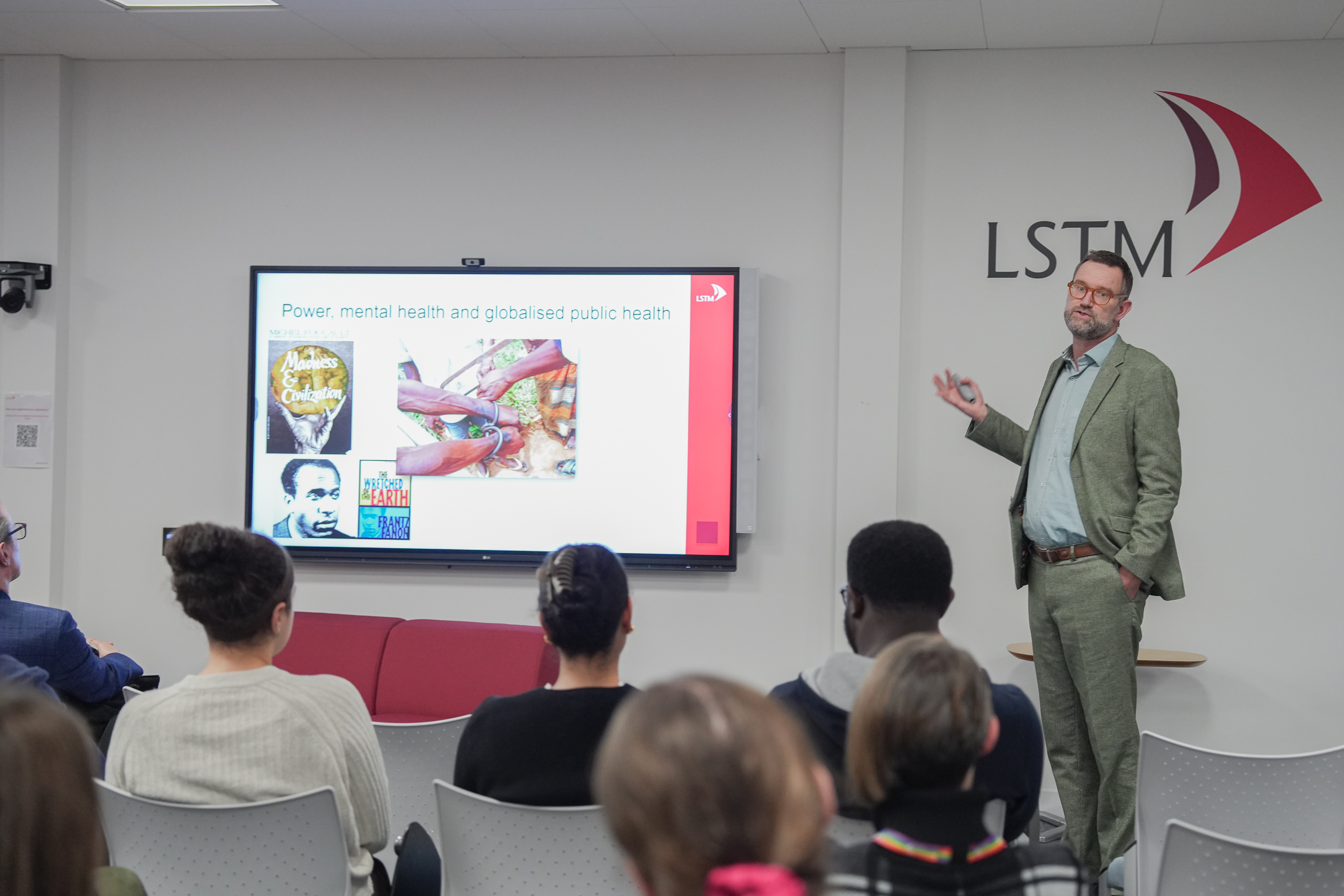
Julian was warmly introduced by his colleague Dr Laura Dean, who remarked on how Julian’s appointment at LSTM reflected a growing advancement in the field of mental health and neglected tropical diseases globally. She spoke briefly about how Julian has spent most of his career outside academia, working as a psychiatrist and mental health worker, valuing the experiences of patients living with mental illness. His current work continues to advocate for advancements in this area through research and his collaboration with key stakeholders in global health decision-making.
A Broader Lens on Mental Health
Julian started his talk by acknowledging that whilst his lecture would focus on mental health, he believes that all disciplines deserve the same level of spotlight to better advance the whole field of global health. He explored the importance of individual and international levels of power that shape which voices are heard to influence change. As a medical student myself, I was particularly struck by how he credited his sociology teaching with helping him move beyond the traditional biomedical model and better understand the socio-environmental factors that shape mental illness.
Early Experiences that Shaped His Career
Julian went on to share moments from his early psychiatry work in Nigeria. The audience was visibly captivated as he spoke about his first experiences of entering a community, where they had to saw the shackles off of a schizophrenic man who had been chained up for years. This was a powerful reminder of how essential his work was for re-engaging people who have been dismissed from their society for so long. He emphasised the importance of being critical of our own standpoint, especially given the colonial legacy of Western psychiatry and the lasting harm caused by asylum systems designed to segregate the most mentally unwell from community support. We must endeavour to listen to the voices of patients and let this guide our decision-making, rather than taking our ideal frameworks and insensitively applying them.
His childhood growing up on the river Congo in Pimu and Upoto in Central Africa and later completing his medical training in London, provided the foundations for Julian’s motivation to make change in the field of global health. He spoke about how he was inspired by the power of protest and collective action to fight against harmful leaders, stating this influence as the origin for the ‘world turned upside down’ theme of his talk. Julian chose to pursue psychiatry, as he felt it offered a unique interaction of relationships, philosophy, and understanding the complexity of the human mind.
Rethinking the Global Health Architecture
The main part of the lecture focussed on dismantling colonial thinking within global mental health and looking at the ways we can address the 90% global treatment gap for people living with mental illness. Julian spoke about Thomas Adeoye Lambo, who championed a new approach where he only saw patients as day cases and would send them into the community to be cared for. Julian went on to critique the historic shortfalls of global health decision making, explaining how the Africa CDC emerged due to the limitations of response from the WHO, paving the way for more regionally led solutions. He ended his talk by illustrating how we are in a time of cataclysmic change surrounding the architecture of global mental health and with mass terminations of humanitarian funds, it is important now more than ever that mental health research becomes directly actionable for communities. He quoted the Ghanaian president, John Mahama, who argued that funding shortages present a real opportunity for change, with the Global South now having to take the lead.
Julian concluded his talk with four necessary resets needed to accelerate progress:
- Enable and amplify the voices of people with lived experiences
- Strengthen research relationships and collaboration
- Tackle commercial determinants of health and improve public health legislation
- Embed solutions for mental health within our understanding of planetary health
Q&A Key Takeaways
Julian emphasised cultural sensitivity when applying human rights and health frameworks, and the importance of using creative tools, like photo voice, to help people comfortably express their experiences. On engaging policy makers and leaders, he argued that mental illness touches nearly every family, so personal and quiet conversations are a powerful tool for change.
Final Thoughts
I left this lecture feeling both challenged and energised for change. Julian’s key message to ‘turn the world upside down’ for mental health, requires us to rethink power sensitively, genuinely listen to affected communities, and ensure that evidence is translated into practice. Engaging in this inaugural lecture series has been a highlight of my time so far at LSTM and reminds me of the wonderful community I am part of, advocating for change in global health. I would encourage anyone to attend future events and get involved.
Reflections by: Elizabeth Freeney (Student Ambassador/ Master of Public Health (Humanitarian Health) at LSTM)